CBC Recording Artists · Established 1991
The Royal City Saxophone Quartet
Ragtime · Classics · Jazz | Guelph, Ontario, Canada
The Six Brown Brothers — A Brief History
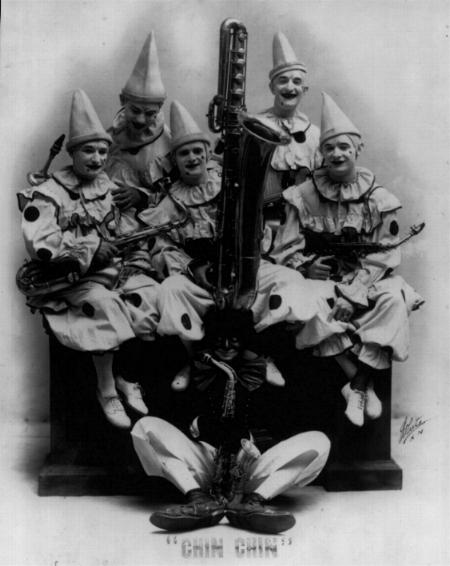
Around 1915, people started talking about a saxophone craze in North America, and by 1917 Tom Brown claimed that the Six Brown Brothers had started it. Maybe they did. The Brown Brothers, growing steadily from two to six between 1903 and 1911, were by 1921 reputed to be the best-paid musical act on the stage. Audiences from England to Australia laughed until their sides ached at Tom’s blackface pantomime in a fanciful red bandsman’s jacket, a huge pink bowtie, white pants starched to look bowlegged, and outsized shoes bought from a sideshow giant. Impersonations of John Philip Sousa conducting, an abandoned pregnant bride in a veil, and King Tut cranked up the hilarity. Theatergoers tapped their feet and hummed along with the Brothers’ dynamic arrangements of the latest popular tunes and an occasional classical transcription thrown in for the higher brows. And when the smiling crowd left the theater, they bought the Browns’ numerous records to continue the fun at home.
The brothers William, Tom, Alec, Percy, Vern, and Fred were born between 1879 and 1890, all but one in Ontario, and by 1895 or so formed a boys band in Lindsay, Ontario, under their father Allan’s direction. Tom ran away from home in 1899 to play for Guy Brothers’ Minstrels, based in Massachusetts. By 1903, he was also the clarinet soloist with the Walter L. Main Enormous Shows circus band, which Percy joined as cornet soloist. The two Brown brothers soon formed a multi-instrumental act in the variety portion of the Guy Brothers show, wowing small-town audiences with tunes on clarinet, cornet, orchestra bells, xylophone, and “fatefully” baritone sax. The sax was a rare bird in Canada and the United States in those days, seen by the public mostly in major concert bands like Sousa’s and Arthur Pryor’s. It was also seen in big circus bands like Barnum and Bailey’s, and occasionally in vaudeville, where its comic potential was as important as the music it produced.
In 1904, Tom and Percy moved to the Ringling Brothers’ Circus, where Fred, Vern, and Alec joined them. A year or two later, Al Sweet, director of the Ringling band, decided to pep up the small post-circus variety show by organizing a saxophone quartet composed of three of the Browns and J. Frank Hopkins. The nucleus of the Six Brown Brothers (snappily named Brown Brothers and Hopkins) sprang to life. During the circus’s winter rest, the act tried small-time U.S. and Canadian vaudeville. By 1908, they had become a quintet, first as Brown Brothers and Doc Kealey, then as Five Brown Brothers, still multi-instrumentalists, but always leaving the audience shouting for more by featuring their all-saxophone ensemble for the last number or two.
The Brothers, with Tom and Fred on altos, Billy Markwith (another Ringling musician) on tenor, Alec on baritone, and Vern on bass, were a resounding flop when they first tried the crucial New York City market in 1909. But Tom reworked the act, and New York loved them when they returned later that year with “Broadway Gaiety Girls”, a burlesque company. Their stage career assured, they said goodbye to the circus forever. In the summer of 1910 they left burlesque and toured in big-time vaudeville on the Orpheum Circuit, covering the U.S. from Chicago west to San Francisco. By Christmas they were back in New York, billed as The World’s Greatest Saxophone Players. In 1911 they made their first records, as the Brown Brothers’ Saxophone Quintette, and by August Percy rejoined to make them Six, again filling Orpheum Circuit houses with music and laughs. From 1912 to 1914 they traveled with one of the last major minstrel companies, Primrose and Dockstader’s, headed by graceful and wealthy Canadian hoofer George Primrose and portly blackface comic Lew Dockstader, famed for his impersonation of Teddy Roosevelt. The Brothers’ roster became more stable from 1912 to 1921, with Polish-born Harry Fink replacing Billy Markwith and real brother William Brown finally joining the group, taking Percy’s place.
Chin Chin’s circus motif put the Browns (except for Tom) into clown outfits until the act broke up in 1933. When the Stone era ended, Tom tried producing his own show, Black and White Revue of 1924, starring himself, his dancer/singer wife Theresa Valerio, the Brothers, Lew Dockstader, and lavishly costumed female impersonator Julian Eltinge, but it was an expensive failure. The Brothers went back into vaudeville, surrounded for a few months by a thirty-piece saxophone band in red and white riding habits, then going alone to Australia in the winter/summer of 1924–25.
Back from Australia, Tom put the Brothers on hiatus as he experimented with a minstrel show and then a dance band, but they didn’t click. A revived Six Brown Brothers toured with the dance band starting in mid-1926, playing movie houses until the end of 1927 and even making a short film of their own in May 1927. As vaudeville’s collapse accelerated, Tom sat out the first half of 1928 altogether, then fielded a new Six Brown Brothers, still including Fred, William, Alec, and Vern, until 1933, when bookings grew too thin to live on. Like thousands of show biz casualties of the Great Depression, the Brothers went their separate ways.
Of the many musicians who once performed as a Brown Brother, at least one is still around to enjoy this tribute: Tom and Theresa’s son Tom Jr. (born in 1912), who toured with the group in 1929–30. The sax craze helped create the wonderful sounds of jazz, swing, and bop, but it began when ragtime was king, and the Brown Brothers deserve a big chunk of the credit for the madness.
Mailing Address
The Royal City Saxophone Quartet
P.O. Box 2896
Elora, Ontario
Canada N0B 1S0
CBC Recording Artists · Established 1991
The Royal City Saxophone Quartet
Ragtime · Classics · Jazz | Guelph, Ontario, Canada
The Six Brown Brothers — A Brief History
Around 1915, people started talking about a saxophone craze in North America, and by 1917 Tom Brown claimed that the Six Brown Brothers had started it. Maybe they did. The Brown Brothers, growing steadily from two to six between 1903 and 1911, were by 1921 reputed to be the best-paid musical act on the stage. Audiences from England to Australia laughed until their sides ached at Tom’s blackface pantomime in a fanciful red bandsman’s jacket, a huge pink bowtie, white pants starched to look bowlegged, and outsized shoes bought from a sideshow giant. Impersonations of John Philip Sousa conducting, an abandoned pregnant bride in a veil, and King Tut cranked up the hilarity. Theatergoers tapped their feet and hummed along with the Brothers’ dynamic arrangements of the latest popular tunes and an occasional classical transcription thrown in for the higher brows. And when the smiling crowd left the theater, they bought the Browns’ numerous records to continue the fun at home.
The brothers William, Tom, Alec, Percy, Vern, and Fred were born between 1879 and 1890, all but one in Ontario, and by 1895 or so formed a boys band in Lindsay, Ontario, under their father Allan’s direction. Tom ran away from home in 1899 to play for Guy Brothers’ Minstrels, based in Massachusetts. By 1903, he was also the clarinet soloist with the Walter L. Main Enormous Shows circus band, which Percy joined as cornet soloist. The two Brown brothers soon formed a multi-instrumental act in the variety portion of the Guy Brothers show, wowing small-town audiences with tunes on clarinet, cornet, orchestra bells, xylophone, and “fatefully” baritone sax. The sax was a rare bird in Canada and the United States in those days, seen by the public mostly in major concert bands like Sousa’s and Arthur Pryor’s. It was also seen in big circus bands like Barnum and Bailey’s, and occasionally in vaudeville, where its comic potential was as important as the music it produced.
In 1904, Tom and Percy moved to the Ringling Brothers’ Circus, where Fred, Vern, and Alec joined them. A year or two later, Al Sweet, director of the Ringling band, decided to pep up the small post-circus variety show by organizing a saxophone quartet composed of three of the Browns and J. Frank Hopkins. The nucleus of the Six Brown Brothers (snappily named Brown Brothers and Hopkins) sprang to life. During the circus’s winter rest, the act tried small-time U.S. and Canadian vaudeville. By 1908, they had become a quintet, first as Brown Brothers and Doc Kealey, then as Five Brown Brothers, still multi-instrumentalists, but always leaving the audience shouting for more by featuring their all-saxophone ensemble for the last number or two.
The Brothers, with Tom and Fred on altos, Billy Markwith (another Ringling musician) on tenor, Alec on baritone, and Vern on bass, were a resounding flop when they first tried the crucial New York City market in 1909. But Tom reworked the act, and New York loved them when they returned later that year with “Broadway Gaiety Girls”, a burlesque company. Their stage career assured, they said goodbye to the circus forever. In the summer of 1910 they left burlesque and toured in big-time vaudeville on the Orpheum Circuit, covering the U.S. from Chicago west to San Francisco. By Christmas they were back in New York, billed as The World’s Greatest Saxophone Players. In 1911 they made their first records, as the Brown Brothers’ Saxophone Quintette, and by August Percy rejoined to make them Six, again filling Orpheum Circuit houses with music and laughs. From 1912 to 1914 they traveled with one of the last major minstrel companies, Primrose and Dockstader’s, headed by graceful and wealthy Canadian hoofer George Primrose and portly blackface comic Lew Dockstader, famed for his impersonation of Teddy Roosevelt. The Brothers’ roster became more stable from 1912 to 1921, with Polish-born Harry Fink replacing Billy Markwith and real brother William Brown finally joining the group, taking Percy’s place.
Chin Chin’s circus motif put the Browns (except for Tom) into clown outfits until the act broke up in 1933. When the Stone era ended, Tom tried producing his own show, Black and White Revue of 1924, starring himself, his dancer/singer wife Theresa Valerio, the Brothers, Lew Dockstader, and lavishly costumed female impersonator Julian Eltinge, but it was an expensive failure. The Brothers went back into vaudeville, surrounded for a few months by a thirty-piece saxophone band in red and white riding habits, then going alone to Australia in the winter/summer of 1924–25.
Back from Australia, Tom put the Brothers on hiatus as he experimented with a minstrel show and then a dance band, but they didn’t click. A revived Six Brown Brothers toured with the dance band starting in mid-1926, playing movie houses until the end of 1927 and even making a short film of their own in May 1927. As vaudeville’s collapse accelerated, Tom sat out the first half of 1928 altogether, then fielded a new Six Brown Brothers, still including Fred, William, Alec, and Vern, until 1933, when bookings grew too thin to live on. Like thousands of show biz casualties of the Great Depression, the Brothers went their separate ways.
Of the many musicians who once performed as a Brown Brother, at least one is still around to enjoy this tribute: Tom and Theresa’s son Tom Jr. (born in 1912), who toured with the group in 1929–30. The sax craze helped create the wonderful sounds of jazz, swing, and bop, but it began when ragtime was king, and the Brown Brothers deserve a big chunk of the credit for the madness.
Mailing Address
The Royal City Saxophone Quartet
P.O. Box 2896
Elora, Ontario
Canada N0B 1S0